
Why International Power Strip Sourcing Requires Extreme Diligence
Overseas wholesalers, consumer electronics importers, project procurement teams, and private-label brand holders face steep commercial and regulatory stakes when sourcing power distribution units and extension sockets from Chinese manufacturers. While China’s manufacturing ecosystem offers unmatched capacity and cost efficiency, an unregulated tier of low-cost factories relies on predatory corner-cutting. This guide unpacks the engineering flaws you must proactively eliminate before releasing production deposits.
The Procurement Paradox: Balances Between BOM Margins and Catastrophic Liability
For overseas enterprise purchasers, purchasing decisions often hinge on fractions of a cent per unit. However, with mains power accessories (operating at 110V–250V and handling continuous currents up to 16 Amperes), a compromised Bill of Materials (BOM) does not simply cause product failure—it creates an active ignition source.
Wholesale clients routinely convey severe anxiety regarding unexpected border confiscations, port-of-entry electrical safety sampling failures, and unmanageable consumer product liability claims. Understanding the engineering anatomy of a power strip reveals how fraudulent factories engineer products to look pristine on the outside while harbor critical safety hazards within.
- Severe Market Penalties: Stringent scrutiny by EU RAPEX, US CPSC, and national trade authorities against non-compliant imports.
- Hidden Material Swaps: Replacing electrolytic oxygen-free copper with copper-clad aluminum (CCA) or recycled brass alloys.
- Inadequate Creepage Distances: Reduced internal clearance distances causing dielectric arcing during minor mains voltage spikes.
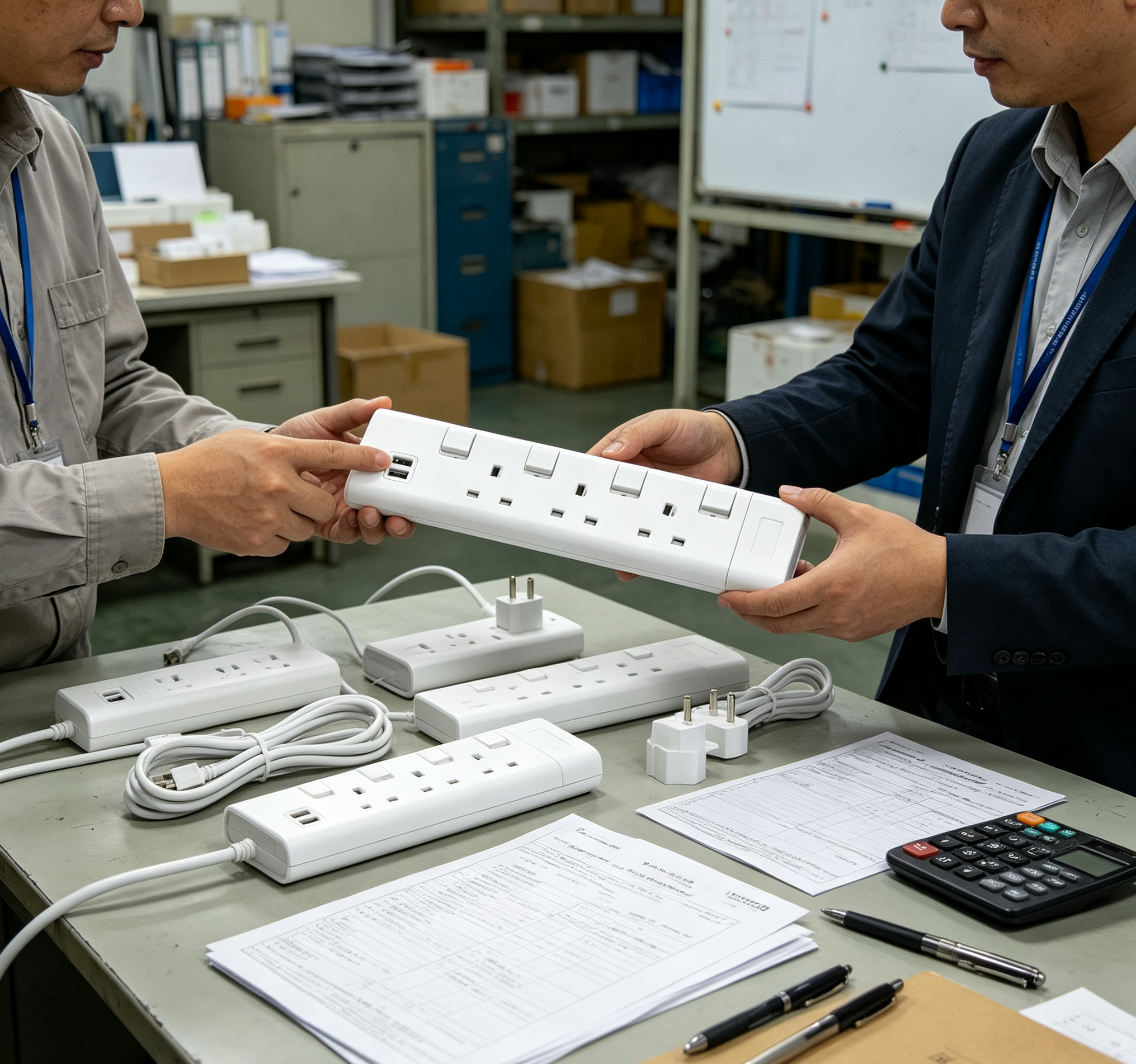
The 5 Most Dangerous Safety Defects in Low-Quality Power Strips
In-depth inspection of compromised electrical assemblies reveals recurring patterns of structural neglect. The following defects represent the primary causes of safety failures identified in sub-tier manufacturing facilities.
1. Undersized & CCA Conductor Wiring
Unethical suppliers substitute genuine Oxygen-Free Copper (OFC) with Copper-Clad Aluminum (CCA) or drastically undersize the nominal cross-sectional area (e.g., stamping a cable as 3x1.5mm² when actual measurements reveal only 3x0.5mm²).
The Hazard: Aluminum has substantially higher electrical resistance than pure copper. Under sustained heavy loads (such as heaters or kitchen appliances), excessive I²R resistive heating occurs, leading to cable sleeve melting, insulation degradation, and direct flash fires.
Conductor Integrity Flaw2. Flammable Enclosures & Recycled ABS
High-specification power outlets necessitate virgin Polycarbonate (PC) or robust engineering resins certified to UL94 V-0 flame retardancy. Substandard producers employ low-grade or recycled ABS plastics mixed with regrind scrap without fire-retardant chemistries.
The Hazard: In the event of internal thermal overload or localized electrical sparking, sub-tier casings ignite rapidly, support open combustion, emit toxic fumes, and drip molten burning resin onto carpets and office furniture instead of self-extinguishing.
Polymer Chemistry Flaw3. Failed or Omitted Overload/Surge Protection
Many units advertise "surge and overload protection" while containing dummy components, undersized Metal Oxide Varistors (MOVs) without thermal fuses, or standard toggle switches completely devoid of bimetallic breaker mechanisms.
The Hazard: When an MOV takes repeated transient spikes without a matching thermal cutoff, it enters thermal runaway, causing the MOV body to explode or catch fire. Absent overload breakers leave the customer's downstream equipment unprotected.
Active Circuitry Failure4. Loose Contacts & Brittle Reclaimed Brass
The interior busbar system requires high-elasticity phosphor bronze (tin-bronze alloy) to maintain clamping tension over thousands of insertion cycles. Cost-cutting factories utilize cheap iron-brass sheet metal or thin iron-plated copper strips.
The Hazard: After minimal insertions, the contacts deform permanently, losing mechanical clamping force. Loose terminal connections yield sharp spikes in contact electrical resistance, sparking, thermal localized arcing, and severe plug melting.
Mechanical Retention Flaw5. Inadequate Creepage & Clearance Spacing
International safety directives stipulate explicit physical distances (typically ≥ 3.0mm to 4.0mm) between Live, Neutral, and Ground traces, as well as between primary high-voltage circuits and secondary USB circuitry.
The Hazard: In humid operating conditions or during common supply surges, insufficient spacing causes flashover dielectric breakdown. This introduces catastrophic mains voltage directly into USB outputs, subjecting connected smartphones or laptops to 230V mains shock.
Isolation & Creepage Hazard6. Forged Safety Marks & Fraudulent Lab Reports
A prevalent trap for unwary purchasers is obtaining genuine-looking test reports displaying CE, UL, VDE, or RoHS symbols, which are either photoshopped, registered under expired licenses, or belong to completely different product models.
The Hazard: Sourcing based on forged certificates strips away all legal protections. Importers assume total criminal and civil responsibility under product safety legislation once cargo passes sovereign customs checkpoints.
Regulatory Fraud RiskThe Exponential Risks of Importing Defective Power Strips
A short-term saving of 5% to 15% on FOB pricing can trigger an avalanche of structural liabilities. When electrical accessories fail in the field, the financial repercussions rarely remain confined to unit replacements.
Customs Interception, Port Seizures & Container Demurrage
Customs agencies (including US Customs and Border Protection, the UK Border Force, and European market surveillance offices) continuously conduct targeted random sampling of high-risk power distribution SKUs. If laboratory testing fails flammability or cord insulation standards, entire multi-container shipments face instant seizure, mandatory destruction at the importer's expense, and hefty demurrage fines.
Mandatory Recalls & Devastating Financial Liabilities
A single domestic fire accident linked to a defective thermal protector triggers an immediate, publicized government-mandated recall. The importer is held directly liable for reverse logistics costs, disposal management, customer compensation, and steep regulatory punitive fines that routinely bankrupt middle-tier trading companies.
Irreversible Brand Erosion & Retail Delisting
Major retail channels, big-box supermarkets, and established e-commerce marketplaces (such as Amazon, Home Depot, and MediaMarkt) operate immediate-strike policies for electrical safety breaches. One published failure causes permanent algorithmic deindexing, merchant account suspension, and catastrophic reputational destruction that takes decades to recover.
Insurance Denials & Catastrophic Legal Claims
Commercial product liability insurance policies almost universally feature standard compliance clauses: coverage is null and void if products fail to meet fundamental statutory electrical safety standards. In the tragic event of personal injury or major commercial structural fires, corporate directors may face severe personal legal liability without insurance indemnification.
How Professional B2B Buyers Identify Substandard Power Strips
Do not rely solely on sales presentations or paper data sheets. Implement this multi-layered physical, metallurgical, and certification inspection protocol throughout your sampling and pre-shipment quality control (PSI) phases.
| Inspection Dimension | Dangerous Substandard Tier | Tier-1 Industrial / Export Grade |
|---|---|---|
| Internal Conductor Material | ✗ Substandard CCA (Copper-Clad Aluminum), iron-tin mix, or recycled scrap copper | ✓ Compliant 99.99% Electrolytic Oxygen-Free Copper (OFC) / High-Purity Red Copper |
| Enclosure Flammability | ✗ Substandard Generic secondary ABS; ignites readily, burns continuously, toxic drip | ✓ Compliant Flame-retardant Polycarbonate (PC); UL94 V-0, 750°C Glow Wire pass |
| Socket Contact Clips | ✗ Substandard Thin reclaimed brass (0.3mm–0.4mm); loses elasticity under 200 cycles | ✓ Compliant Integral Phosphor Bronze Busbar (0.5mm–0.7mm); >5,000 smooth cycles |
| Cord Gauge Compliance | ✗ Substandard Marked 3G1.5mm² but measured at 0.5mm²–0.75mm² (overheating risk) | ✓ Compliant Strict calibration to IEC 60227 / UL 62 cord sets (100% full copper cross-section) |
| High-Voltage Dielectric Test | ✗ Substandard Arc-overs occur below 1,500V; low insulation resistance (<2 MΩ) | ✓ Compliant Withstands 2,500V–3,750V Hi-Pot testing for 60s; insulation >100 MΩ |
| Surge Protection Circuitry | ✗ Substandard Undersized naked MOV with zero thermal protection or disconnect logic | ✓ Compliant Multi-stage MOV array with embedded thermal cutoffs & LED status monitoring |
Phase 1: Raw Material Validation
Always dissect pre-production samples. Strip the cable sheath to inspect stranded conductors. Perform a flame-test on the core wires: pure copper forms a clean bead without quickly snapping or burning into white ash (a telltale indicator of cheap aluminum cores).
Phase 2: Stress & Hi-Pot Testing
Demand a standardized Hi-Pot (dielectric withstand) test and a continuous full-load temperature rise test (IEC 60884-1 standard). Under maximum nominal load (e.g., 16A continuous for 1 hour), the terminal temperature rise must stay comfortably under 45K.
Phase 3: Database Certification Auditing
Never accept static PDF certificates. Cross-reference license numbers directly within official registries: UL Product iQ, TÜV Rheinland Certipedia, BSI Kitemark directory, or the Intertek ETL database to verify the certificate matches the exact manufacturing plant.
How Our Manufacturing Infrastructure Eliminates Safety Hazards
We operate an advanced, ISO 9001-certified electrical equipment manufacturing center engineered specifically to serve tier-1 global importers, brand distributors, and industrial clients who demand uncompromising electrical integrity.
100% Incoming Spectrometric Material Verification
Every single batch of incoming copper rods, phosphor bronze coils, and polymer resins passes through strict laboratory spectrometer assays and melt-flow index tests before being released to production. We tolerate zero reclaimed resin in our structural molds.
Integrated SMT & Automated Welded Busbars
We eliminate messy point-to-point manual hand soldering—the primary cause of cold solder joints and internal arcing. Our units employ continuous, automated stamped phosphor-bronze busbar strips or robotic ultrasonic welding for consistent electrical conductance.
100% Inline End-of-Line (EOL) Automated Testing
Every single power strip leaving our automated conveyor lines undergoes high-voltage ground continuity checks, Hi-Pot isolation testing, correct socket polarity verification, and automated shutter mechanical insertion tests. Defective units are rejected automatically.
Full International Certification Portfolios
We maintain active, verifiable certifications across major global jurisdictions: UL 1363 / UL 1449 (North America), CE / LVD / RoHS (Europe), BS 1363/A (United Kingdom), AS/NZS 3105 (Australia/New Zealand), and SASO (Middle East), backed by accredited test laboratories.
Child-Safety Shutter & Arc-Quenching Design
Every consumer socket is equipped with bi-directional interlocked protective shutters requiring simultaneous dual-pin insertion force (>40N), preventing single-prong insertion of foreign metal objects by children and providing reliable safety in all operating environments.
Traceable Batch Serialization & Full Transparency
We provide full batch transparency. Every master carton and inner product shell incorporates lot-numbered micro-markings linking back directly to raw copper melts, SMT production records, quality inspector IDs, and complete outbound container tracking files.
Secure Your Next Power Strip Production Run with Zero Safety Compromises
Partner with an engineering-led manufacturing partner dedicated to safeguarding your commercial brand reputation. Contact our technical engineering team today for full factory audit reports, genuine accreditation dossiers, customized OEM/ODM quotes, and precision laboratory samples.
Request Technical Spec Sheet & Factory Audit